
You have a pending charge. Maybe it is something minor. Maybe it is more serious. Either way, you are applying for jobs and the background check question is sitting in the back of your mind like a fog you cannot shake.
Will it show up? Will it cost you the offer? Do you have to disclose it?
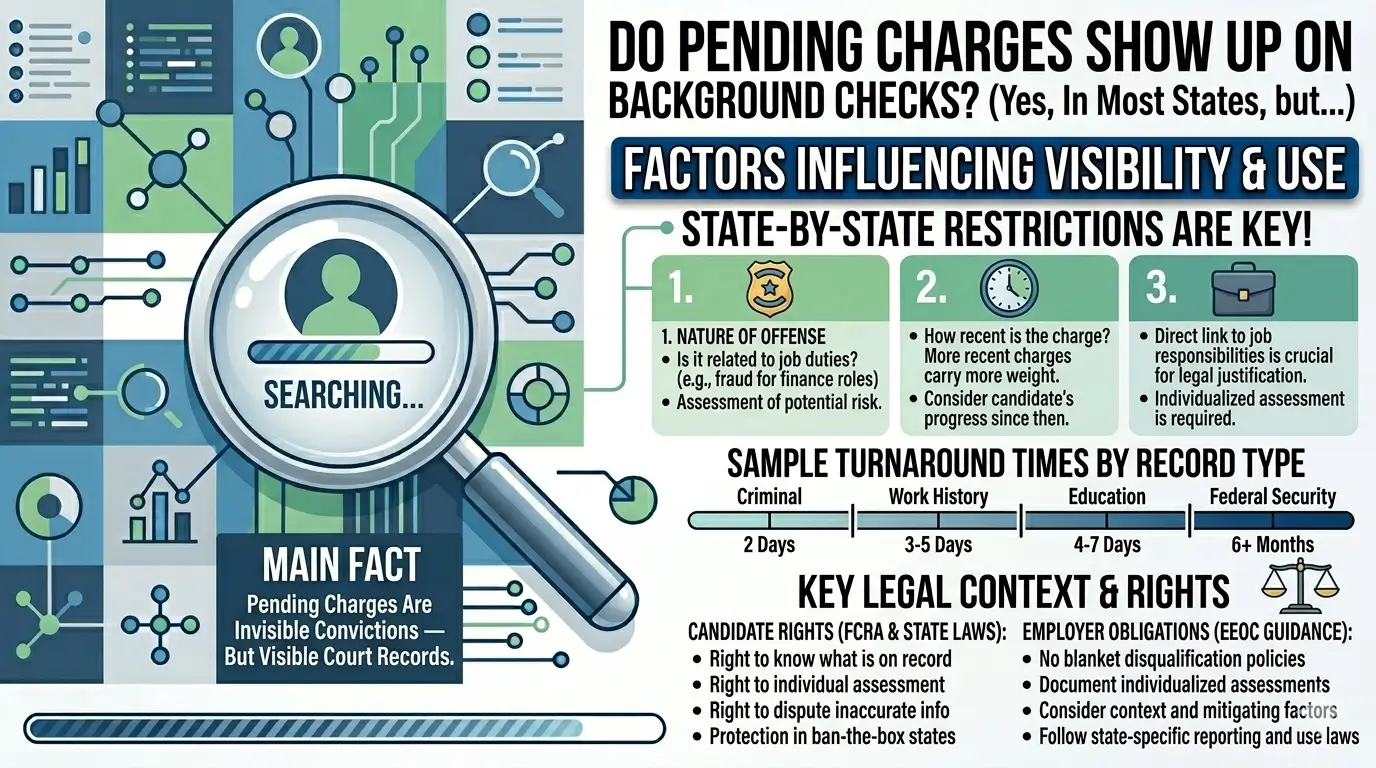
Here is the direct answer: in most states, yes, pending charges will appear on a background check. But the details matter a lot. Whether a pending charge shows up, how it is treated by employers, and what legal protections you have depend on several factors that most guides do not fully explain.
This post breaks all of it down. What a pending charge actually is, when it shows up and when it does not, which states protect you, what employers can and cannot do under federal law, and exactly how to handle it as a candidate.
Quick answer: Pending charges appear on background checks in most states, particularly at the county level. However, several states restrict or prohibit their use in hiring decisions. A pending charge is not a conviction, and employers are legally required to assess it individually before making a hiring decision.
Before getting into background checks, it helps to be precise about what a pending charge actually means, because a lot of people confuse arrest records, pending charges, and convictions.
An arrest record means law enforcement took you into custody. No formal charge has been filed yet.
A pending charge means a prosecutor has formally filed criminal charges, but the case has not yet reached a final outcome. The defendant has not been convicted, acquitted, or had the charges dismissed. The case is open and active in the court system.
A conviction means the court process concluded with a guilty verdict or guilty plea.
This distinction matters because iprospectcheck notes that many states have different rules for each category. A state that prohibits reporting arrests without convictions may still allow pending charges to appear, because a charge represents a formal legal proceeding, not just a police encounter.
In other words: being arrested is not the same as being charged, and being charged is not the same as being convicted. Each carries different weight on a background check and under employment law.
In most cases, yes. Here is why.
When a prosecutor files charges, the case enters the public court record. Background screening companies access county courthouse records, state criminal databases, and federal records as part of a comprehensive search. According to BackgroundChecks.com, you may see a case status labeled "pending" or "awaiting disposition" on a background report. This is distinct from a conviction, but it is visible.
However, visibility depends on several variables:
As SRA Screening explains, most state laws allow employers to view pending charges as part of a criminal records check. The more comprehensive the search, the more likely a pending charge will appear.
Key point: County-level checks are the most accurate and up-to-date source for pending charges. If an employer only runs a national database search, a recent pending charge in a specific county may not appear. Employers who need comprehensive coverage should order county checks for every jurisdiction where the candidate has lived or worked.
.webp)
These three categories show up differently on background reports and carry different legal implications for employers.
Record type
Shows on background check
Employer can use for hiring decision
Arrest only
Rarely — many states prohibit
Generally no — not proof of conduct
Pending charge
Yes in most states
Yes, but individualized assessment required
Conviction
Yes in virtually all states
Yes, subject to FCRA and state law limits
Dismissed charge
Varies — some states restrict
No — should not affect hiring decision
This is where it gets complicated. There is no single federal law that universally governs how pending charges are reported or used in hiring decisions. Instead, a patchwork of state laws creates dramatically different outcomes depending on where the charge was filed.
States With Strong Restrictions on Pending Charges
According to ScoutLogic Screening, here is how major states handle pending charges:
States With Fewer Restrictions
In most other states, pending charges are visible on background check reports and employers have broader latitude to consider them. Texas has a notable rule: for positions paying under $75,000, employers cannot consider pending charges that did not result in conviction or are still under investigation. For positions paying over $75,000, no such restriction applies.
The Federal Layer: Ban the Box
At the federal level, the Fair Chance to Compete for Jobs Act (signed into law in 2019) prohibits federal agencies and federal contractors from asking about criminal history before making a conditional offer. According to the National Employment Law Project, 37 states and over 150 cities and counties have adopted some form of ban-the-box policy, with 15 states extending these rules to private employers.
Ban-the-box laws do not necessarily prevent pending charges from appearing on a background check. They regulate when an employer can ask about criminal history during the hiring process. Even in ban-the-box jurisdictions, employers can still run checks after a conditional offer is made.
Even in states that allow pending charges to appear on background reports, employers do not have unlimited authority to act on that information. Federal law sets important guardrails.
The EEOC's Individualized Assessment Requirement
The Equal Employment Opportunity Commission (EEOC) issued enforcement guidance under Title VII of the Civil Rights Act making it clear that blanket exclusion policies based on criminal history are potentially discriminatory. According to the EEOC's enforcement guidance, an arrest record alone is not proof that criminal conduct occurred. An employer cannot automatically reject a candidate based on a pending charge without considering whether it is actually relevant to the job.
The EEOC's framework, rooted in the Green Factors from the 8th Circuit, requires employers to evaluate:
Beyond these three factors, a proper individualized assessment should also consider rehabilitation efforts, prior successful employment, character references, and any mitigating circumstances the candidate wants to share.
What Blanket Policies Cost Employers
The EEOC enforcement record shows that blanket exclusion policies carry real financial and legal risk. Dollar General settled for $6 million after categorically excluding applicants based on criminal history without individualized assessment. BMW paid $1.6 million for a similar policy. According to Nisar Law Group, employers who maintain rigid denial policies face significant legal and financial exposure under Title VII.
The FCRA's Seven-Year Rule: Does It Apply to Pending Charges?
The Fair Credit Reporting Act limits non-conviction information to a 7-year lookback period for most positions. However, as SRA Screening notes, this 7-year limit typically does not apply to pending charges because they represent an unresolved legal matter, not a closed non-conviction record. A pending charge filed 3 years ago that is still open in the court system can appear on a background report regardless of the 7-year rule.
Adverse Action Process Still Applies
Even when an employer decides not to hire based on a pending charge, the FCRA adverse action process must be followed. The employer must provide a pre-adverse action notice, give the candidate a copy of the report, allow a reasonable window to dispute or explain, and then issue a final adverse action notice if they proceed. Skipping these steps exposes employers to FCRA liability.
Not all background checks are the same. How and whether a pending charge appears depends heavily on the type of search ordered.
County Criminal History Checks
County checks are the most granular and the most likely to surface pending charges quickly. Researchers access courthouse records directly, which typically have the most current information. This is the most reliable source for pending case statuses.
State Criminal Database Searches
State databases aggregate records from various sources but may lag behind county courthouses by days or weeks. A pending charge filed recently may not yet appear in a statewide database search.
National Criminal Database Searches
National databases compile records from multiple states but are the least current. They are useful for broad sweeps but should not be the only search used when thoroughness matters. Pending charges may or may not be included depending on data refresh cycles.
Federal Criminal Searches
Federal searches cover crimes prosecuted at the federal level across the 94 U.S. federal judicial districts. If a pending charge involves a federal offense such as fraud, identity theft, or drug trafficking across state lines, it will appear in a federal search. These databases tend to be more current than state-level aggregators.
FBI Fingerprint-Based Checks
Used for sensitive government and regulated industry positions, FBI fingerprint searches are comprehensive and will surface pending charges at both the state and federal level. These are the most thorough background checks available and leave very little out.
The weight an employer places on a pending charge varies significantly by industry and the specific duties of the role.
Financial Services
Banks and financial institutions are heavily regulated. Federal law under the Federal Deposit Insurance Act prohibits hiring individuals with pending charges involving crimes of dishonesty, breach of trust, or money laundering, even before a conviction. A pending money laundering charge can legally prevent a bank from hiring the candidate regardless of the individualized assessment framework.
Healthcare
Healthcare positions often require state licensing, and licensing boards have independent authority to restrict or condition licenses based on pending charges. Positions involving vulnerable populations face the most scrutiny. Pending charges involving violence, abuse, or controlled substances are especially disqualifying.
Education and Childcare
Positions involving children require fingerprint-based checks in most states and have the lowest tolerance for any unresolved criminal matter. Pending charges involving assault, sexual offenses, or drug distribution will almost certainly pause the hiring process.
Law Enforcement and Security
Government and law enforcement positions have strict suitability requirements that include pending charges in their assessment criteria. Active criminal proceedings are typically automatic barriers to employment in these roles until fully resolved.
Technology and SaaS
Most tech employers run standard background packages and treat pending charges through an individualized assessment lens. A pending misdemeanor charge unrelated to the job duties is often treated very differently than a pending charge for fraud when hiring someone who will handle customer financial data.
Background check databases do not always update automatically when a case resolves. Here is what happens to a pending charge depending on the outcome:
Conviction
If the case results in a guilty plea or verdict, the charge is converted to a conviction on the court record. On future background checks, it will appear as a conviction rather than a pending charge. This generally carries more weight with employers.
Dismissal or Acquittal
If charges are dismissed or the defendant is acquitted, the case is closed with no conviction. Many states restrict how employers can use dismissed charges. Under EEOC guidance, a dismissed charge should not be treated as evidence of criminal conduct.
However, the dismissed charge may still appear on background reports as a closed case, depending on the state and the database. In states that prohibit reporting non-conviction records, dismissed charges should eventually be removed. If they appear incorrectly after dismissal, the candidate has the right to dispute the report under the FCRA.
Expungement
Once a case is resolved in the defendant's favor, many states allow expungement, which seals or erases the record. An expunged charge generally does not appear on standard employment background checks. According to Protection Plus Solutions, the process and eligibility vary by state, typically requiring a petition to the court and meeting specific criteria such as having no subsequent offenses. Some states allow expungement of pending charges that were dismissed without a trial.
Charges That Linger
Some pending charges remain open for months or even years before reaching resolution. A case involving multiple defendants, extensive evidence review, or complex jurisdictional issues can stay in pending status for a long time. During this period, the charge continues to appear on background checks.
If you have a pending charge and are applying for jobs, the worst thing you can do is be caught off guard. The second worst thing is lie about it.
Know What Is on Your Record
Before applying anywhere, run a personal background check on yourself. Know what databases show, what the case status says, and whether there are any inaccuracies. Some screening companies offer personal report services that show exactly what employers will see.
Understand the Law in Your State
If you are in California, Illinois, Nevada, Colorado, New York, or another state with strong pending charge restrictions, you may have significantly more protection than you realize. In these states, employers in many cases cannot even ask about your record until after a conditional offer. Know your rights before the conversation starts.
Be Prepared to Discuss It Professionally
In states where employers can consider pending charges, you will likely be asked. Have a clear, factual, and non-defensive explanation ready. Focus on context and what the current case status is. If the charge is completely unrelated to the job, say so clearly. If there is a resolution date anticipated, mention it.
Consult an Attorney if the Charge Is Serious
For pending felonies or charges that are directly relevant to the role you are pursuing, speak to a criminal defense attorney before the job application stage. An attorney may be able to advise on case timing, the potential for dismissal, or whether a plea arrangement might affect how the charge appears on background reports.
Dispute Inaccurate Records
If a charge that was dismissed, sealed, or expunged is still appearing on your background report, you have the right under the FCRA to dispute it with the screening company. The company is required to investigate and correct inaccurate information. Document everything and follow up in writing.
Do Not Rely on the "It Probably Won't Show Up" Hope
Some candidates assume a recent or minor charge will not surface in time. This is not a reliable strategy. County-level checks can surface pending charges within days of filing. Plan as if the charge will appear and manage the situation proactively.
Employers who encounter pending charges on a background report need a consistent, legally defensible process. Flying by gut instinct in this area is expensive.
Does a pending charge automatically disqualify me from a job?
No. Under EEOC guidance, employers cannot automatically disqualify a candidate based on a pending charge. They are required to conduct an individualized assessment that considers the nature of the charge, its relevance to the job, and mitigating circumstances. Blanket disqualification policies have resulted in multi-million dollar settlements against major employers.
How long does a pending charge stay on a background check?
A pending charge stays on background reports as long as the case remains open in the court system. Once the case is resolved through conviction, dismissal, acquittal, or expungement, the status changes. In some states, non-conviction records including dismissed pending charges must be removed from reports after 7 years under FCRA guidelines.
Can an employer see a pending charge before it goes to trial?
Yes. Once charges are formally filed, the case enters the public court record and becomes searchable. County-level criminal searches can surface pending charges within days of filing, often well before the case reaches a trial date.
What is the difference between a pending charge and a pending arrest?
An arrest is a police action. A pending charge is a formal accusation filed by a prosecutor in the court system. An arrest without charges being filed will not typically appear as a pending charge, though arrest records may show up separately depending on state reporting laws.
If my charges are eventually dismissed, will they be removed from background checks?
It depends on the state and the database. In states that prohibit reporting non-conviction records, dismissed charges should be removed or blocked. However, this does not happen automatically in all databases. You may need to petition for expungement or file a FCRA dispute with the screening company to ensure the record is corrected.
Does the 7-year FCRA rule apply to pending charges?
Generally no. The FCRA's 7-year limit on non-conviction information typically does not apply to charges that are still pending, because the case has not yet been resolved. An open pending charge is not a closed non-conviction record. Once resolved without conviction, the 7-year limit may then apply depending on the state.
Should I disclose a pending charge before being asked?
In ban-the-box states, employers legally cannot ask about criminal history before a conditional offer, so disclosing it early may not be appropriate or necessary. In other states, proactive disclosure can demonstrate transparency and give you control of the narrative. The right approach depends on the state and the role. When in doubt, consult an attorney.
Pending charges are not convictions. They are not proof of guilt. But in most states, they will appear on a background check and they can affect hiring decisions.
The most important things to understand are:
Whether you are a job seeker trying to understand your exposure or an employer trying to build a legally sound screening program, the rules are clear once you know where to look. Ignorance of state law and EEOC guidance is not a defense. Knowledge is.
Sources
iprospectcheck: Do Pending Charges Show Up on a Background Check
SRA Screening: Do Pending Charges Show Up on a Background Check
BackgroundChecks.com: Pending Charges on Background Checks
ScoutLogic: Do Pending Charges Show Up on Background Checks
EEOC: Enforcement Guidance on Arrest and Conviction Records
Nisar Law Group: EEOC Guidance on Criminal Background Checks
National Employment Law Project: Ban the Box Fair Chance Hiring
Protection Plus Solutions: Do Pending Charges Show Up on a Background Check
Getphyllo: Do Pending Charges Show Up on a Background Check
iprospectcheck: Ban the Box Laws by State