How Long Do Background Checks Take for Jobs?
You nailed the interview. The hiring manager loved you. You got the verbal offer.
Then they say it: "We just need to run a background check."
Suddenly the clock starts ticking. When will it come back? Is no news good news? Should you keep applying elsewhere?
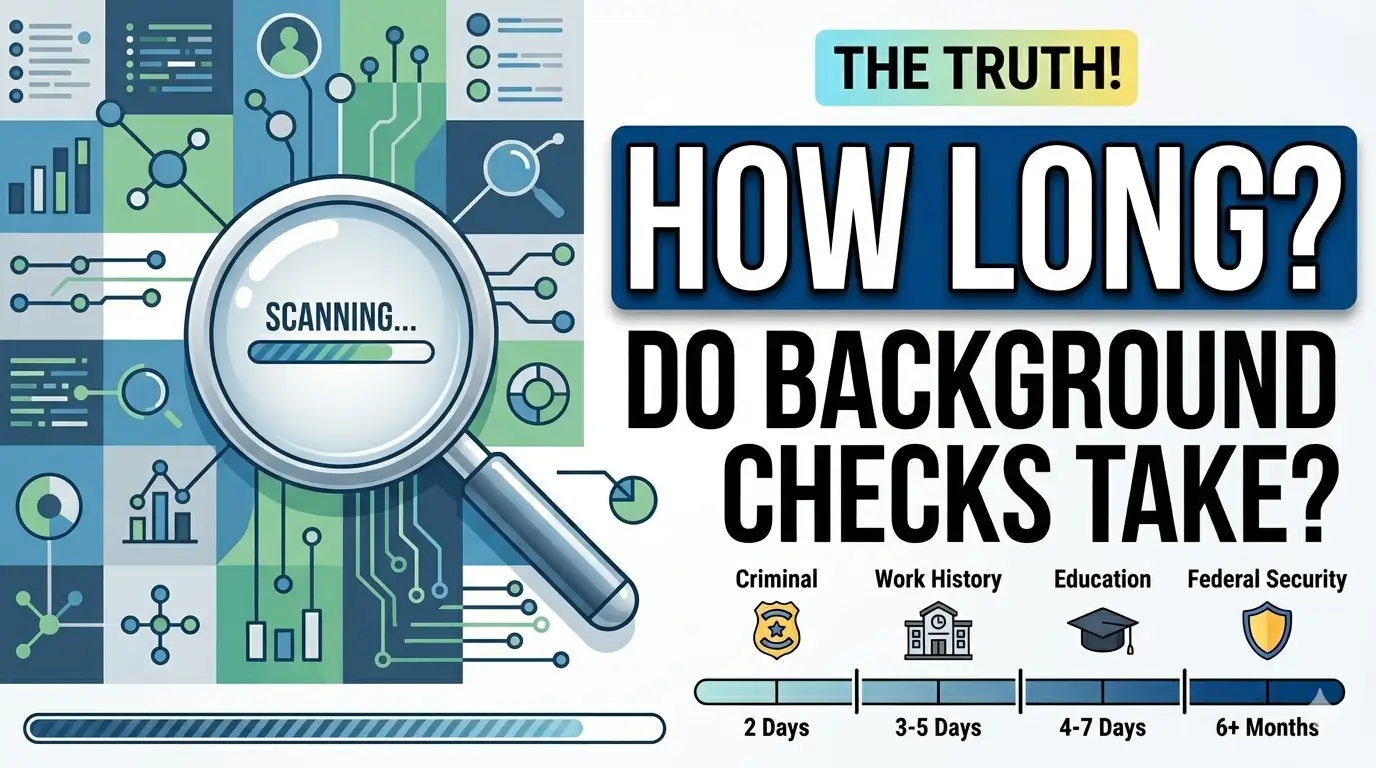
Here is the straightforward answer: most standard employment background checks take between 2 and 5 business days. But that range can stretch from a few hours to several weeks depending on what is being checked, where you have lived, and how quickly third parties respond.
This guide breaks down every major type of background check, what drives delays, what you can do to speed things up, and when to actually start worrying. Whether you are a job seeker or an HR professional, this is the timeline breakdown you need.
Quick answer: Standard employment background checks take 2 to 5 business days. Criminal checks through modern platforms can return results in under an hour. Government security clearances can take 6 months to over a year.
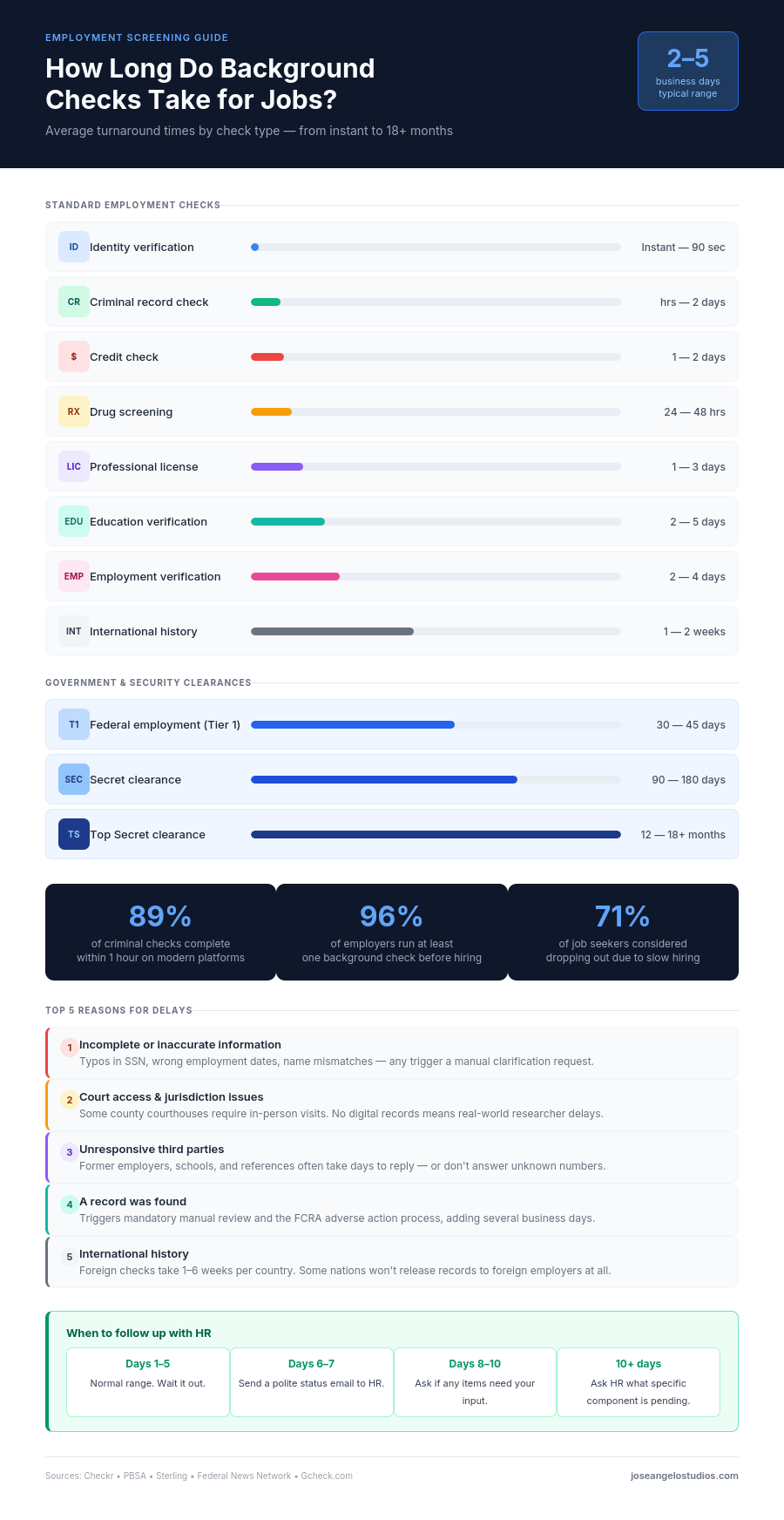
Background checks are not one-size-fits-all. The timeline depends almost entirely on what is being verified. Here is a quick breakdown before we go deeper:
According to Checkr, 89% of criminal background checks are completed within one hour. But a full employment screening package that includes verification of work history, education, and references is a different story.
The Professional Background Screening Association (PBSA) reports that 96% of employers conduct at least one type of background screening before making a hire.
1. Criminal Record Checks
This is the backbone of most employment screenings and also the fastest moving piece. If a candidate has only lived in one state with no complex history, results often come back in one to two business days.
The complication comes with scope. A national criminal database search is fast. A county-level courthouse search is slower, especially when records are not digitized. As noted by Risk Assessment Group, thousands of local government record systems across the US still rely on paper files, handwritten notes, and inconsistent filing systems.
Bottom line: basic criminal check returns in hours to 2 days. Multi-jurisdiction or court-level checks can extend to 5 to 7 business days.
2. Employment Verification
Verifying past employment sounds simple but it is often the slowest piece of the puzzle. According to Indeed, this process typically takes 2 to 4 business days. The more jobs a candidate has held, the longer it takes.
Candidates with international work history push this timeline to 1 to 2 weeks.
3. Education Verification
Confirming degrees, certifications, and enrollment records takes a few days but can run longer if the school has no digital records. The candidate must typically sign a release form before the check can proceed.
4. Credit Checks
Credit checks return within 1 to 2 business days. Employers must follow Fair Credit Reporting Act (FCRA) requirements when using credit data in hiring decisions.
5. Drug Screening
Drug tests must be scheduled in advance and results typically take 24 to 48 hours for a standard urine panel. Non-negative results can push that out another 24 to 72 hours.
6. Professional License Checks
Most licensing boards have online databases. Expect 1 to 3 business days.
Most slow background checks come down to one of five causes.
1. Incomplete or Inaccurate Information
A typo in a Social Security Number, a wrong employment date, a misspelled name — any of these can stall the process. According to Perfect Fit Background Checks, providing a candidate's middle name is especially important for common names.
2. Court Access and Jurisdiction Issues
Some county courthouses do not have digitized records. A researcher physically has to visit the courthouse to pull records. Multi-state criminal histories multiply the problem.
3. Unresponsive Third Parties
Previous employers, schools, and references are often the bottleneck. Spam call filters mean many people will not pick up from unknown numbers. Candidates should give their references a heads-up.
4. A Record Was Found
When a record shows up, a human reviewer must assess whether it is relevant and reportable. FCRA mandates that the candidate receive a copy and a reasonable opportunity to dispute the findings.
5. International Components
Foreign checks can take 1 to 6 weeks per country. Some countries do not release criminal records to foreign employers at all. Cisive notes that checks involving organizations outside your local area always take longer.
Healthcare
Expect 3 to 7 business days for a standard package. OIG exclusion checks, DEA license verification, professional license checks, and criminal screenings are typical.
Finance and Banking
Financial services firms add credit checks and FINRA BrokerCheck searches on top of the standard package. Budget 5 to 7 business days.
Education and Childcare
Sex offender registry checks, fingerprint-based FBI checks, and state-specific childcare exclusion databases are standard. Timeline: 5 to 10 business days.
Technology and SaaS
Most tech companies run standard packages. Turnaround is typically 3 to 5 business days through a modern CRA platform.
Government and Defense
Standard federal checks (Tier 1) take 30 to 45 days. Secret clearance takes 90 to 180 days. Top Secret routinely stretches 12 to 18 months. DCSA conducts the vast majority of federal clearance investigations.
The three stages of a security clearance: (1) application and SF-86 submission, (2) investigation, and (3) adjudication.
According to Federal News Network, top-secret investigation timelines averaged 115 days for the fastest 90% of cases in fiscal 2023. During the peak backlog in 2018, it was taking over 400 days.
Incomplete SF-86 forms add 60 to 90 days to processing timelines according to Gcheck.com.
Key tip for clearance applicants: Disclose everything. Gaps, foreign contacts, financial issues, past drug use. Investigators will find it anyway, and omissions raise far bigger red flags than the underlying issue itself.
According to Sterling's Hiring Reimagined research, 71% of recent job seekers considered dropping out or actually dropped out of a hiring process because it took too long and was too complicated.
Most employers do not send a formal pass notification. If the check clears, onboarding just moves forward.
If something in the report affects the hiring decision, under the FCRA the employer must:
According to Second Chance Info, if your background check has been pending for more than 5 to 7 business days, it is usually a procedural delay, not a sign that you failed.
Does a long background check mean I failed?
Not necessarily. Most delays are procedural. Court access issues, slow employer responses, and common names requiring extra verification are all common causes.
Can a background check come back in one day?
Yes. Identity verification is essentially instant for digital checks. Simple national criminal database searches can return results in under an hour.
Does receiving a background check mean I got the job?
It means you are the leading candidate. Most employers only run background checks on finalists. The offer is typically conditional on the results.
What causes a background check to take 2 weeks?
International history, multi-state criminal searches requiring courthouse visits, unresponsive previous employers, education verifications for institutions without digital records, or a record appearing that triggers manual review.
What does it mean when a background check says pending?
Pending means the screening company is still waiting on information from one or more sources. It does not mean something negative was found.
How far back do employment background checks go?
Most employment background checks cover 7 years for criminal convictions and work history. For positions paying over $75,000 annually, FCRA lookback restrictions do not apply.
The realistic timeline for most candidates: 2 to 5 business days for standard employment screening. Criminal checks alone can clear in hours. Government clearances can take months or over a year for top-level positions.
Be accurate, be complete, and be proactive. Most background check delays are preventable. The job market moves fast. Do not let paperwork be the bottleneck.
Sources
Checkr: How Long Does a Background Check Take
Indeed: How Long Do Background Checks Take for a Job
Gcheck: How Long Does a Background Check Take
Cisive: How Long Does a Pre-Employment Background Check Take
Risk Assessment Group: How Long Are Background Checks
Federal News Network: Security Clearance Timelines
Gcheck: How Long Do Background Checks Take for Government Jobs
Second Chance Info: How Long Do Background Checks Take