
Last year, Americans handed strangers $1.16 billion.
Not to charities. To people they had never met in person — online matches, "friends" from social platforms, and voices on the other side of a screen who turned out to be someone else entirely. In just the first nine months of 2025, the Federal Trade Commission logged 55,604 romance scam complaints, up 22% from the year before. Nearly 60% of romance scam victims said it started on social media.
Here's the uncomfortable part.
Most of those people could have spotted the lie in about ten minutes. That's roughly how long it takes to learn how to run a background check on someone — and running one takes even less.
This isn't a skill reserved for HR managers and landlords anymore. Whether you're vetting a new hire, screening a tenant, hiring a babysitter, meeting a date in person for the first time, or going into business with someone you met online, a background check turns assumptions into facts. This guide walks you through every realistic way to do it — the free routes, the professional route, what each one actually reveals, and where the law draws the line.
Let's start with the question almost everyone skips.
Before you type a single name into a search bar, answer one question: why are you checking this person?
It matters more than you'd think.
The method, the depth, and even the legality of your search all hinge on your purpose. A quick safety check before a first date has a very different bar than screening someone who'll have keys to your house or access to your bank account. And screening an employee or a tenant pulls you into a whole different legal universe (more on that below).
So sort your situation into one of these buckets:
Why does this matter so much? Because a free Google search might be perfectly fine for the first bucket, completely inadequate for the second, and illegal to rely on for the third. Match the tool to the job, and you'll save yourself time, money, and a potential lawsuit.
Now, let's get into the actual methods — starting with the ones that cost nothing.
You can uncover a surprising amount about almost anyone without spending a dime. The catch? It takes patience, and the picture you get is rarely complete. But it's the right starting point for casual, personal vetting.
Here's where to look.
Start with the obvious — but do it like an investigator, not a casual scroller.
Put the person's full name in quotation marks and pair it with a city, employer, or username. Then try image search: drop their profile photo into a reverse-image tool to see whether that "successful entrepreneur in Dubai" is actually a stock photo or a stolen picture from someone else's account. This single trick exposes a huge share of catfish and romance-scam profiles.
Next, read their social footprint sideways. Don't just look at what someone posts — look at when an account was created, how many real connections it has, and whether the story it tells matches reality. A six-month-old profile with two friends and a glamorous lifestyle is a red flag, not a romance.
But here's the limit: social media shows you a curated highlight reel, not a criminal record. It's a starting point, never the whole answer.
Most criminal and civil cases live at the county level, and most counties now publish at least some records online.
Find the county where the person lives (or has lived) and search the clerk of court's website for case records. You can often pull up civil suits, evictions, traffic matters, misdemeanors, and felonies filed in that jurisdiction. Many counties also let you walk into the clerk's office and request records in person.
The downside? You have to know which counties to search. Someone who's lived in four states over the past decade requires you to hunt through every relevant jurisdiction — and a record filed in a county you didn't think to check simply won't show up.
Some states maintain a centralized criminal history database the public can request.
A handful offer instant online name-based searches; others require a mailed form, a fee, and sometimes fingerprints. New York's statewide search, for example, runs through the court system's Direct Access program for a per-search fee. Coverage and rules vary wildly from state to state, so check your specific state's court administration or department of public safety website.
This one's free, fast, and worth running on anyone who'll be near your kids.
The U.S. Department of Justice operates the National Sex Offender Public Website (NSOPW.gov), which searches registries across all states, territories, and tribal jurisdictions in a single query. Enter a name or browse by location. It's one of the few genuinely nationwide free tools available to the public.
For federal matters — fraud, drug trafficking, white-collar crime, federal bankruptcy — county searches won't help. Those cases sit in federal court.
PACER (Public Access to Court Electronic Records) gives the public access to more than a billion documents across federal appellate, district, and bankruptcy courts. There's no registration fee, and if your usage stays under $15 in a quarter, the fees are waived entirely. It's the single best free resource for catching financial and federal criminal history that local searches miss.
Want to go deeper on doing this the right way? The University of Minnesota Libraries publishes a practical, no-cost research guide on locating public records information that maps out where different record types actually live — a useful companion if you're piecing together a DIY check.
So you can do all of this yourself. The real question is whether you should rely on it — and that's where free checks start to break down.
Free methods are great for a gut-check. They're terrible for a decision that actually matters.
Here's why.
They're incomplete by design. No single free source connects every county, every state, and every federal court into one report. You're stitching together fragments, and the fragment you miss is usually the one that mattered. A felony conviction filed 18 months ago in a county you didn't think to search stays invisible.
Name confusion is everywhere. There are a lot of John Smiths. Without a verified Social Security number and date of birth to anchor the search, free tools routinely surface the wrong person's record — or miss the right person's record because it's filed under a maiden name or alias.
Free "people-search" sites are not background checks. Those flashy sites promising "instant background reports" are data aggregators, not consumer reporting agencies. Their data is often stale, frequently wrong, and — critically — they explicitly state their reports cannot legally be used for employment, tenant, or credit decisions. Treating them as a real screening tool is a mistake on both accuracy and compliance.
The time cost is brutal. A thorough DIY check across multiple jurisdictions can eat an entire afternoon. For one person. Multiply that across a hiring round or a stack of rental applications and the "free" option becomes the most expensive one you have.
And then there's interpretation. Even when you find a record, knowing what it means is its own skill. Is a charge the same as a conviction? Does a dismissed case count? Our guide on whether a charge will show up on a background check breaks down the difference between charges, convictions, and dismissals — and our explainer on whether an arrest shows up on a background check covers why an arrest without a conviction is treated very differently under the law.
The bottom line? Free works for curiosity. For anything with real stakes, you need something built for accuracy.
| Factor | Free / DIY Search | Professional Report (CRA) |
|---|---|---|
| Cost | $0 (your time only) | Flat per-report fee |
| Speed | Hours across multiple sites | Minutes |
| Coverage | Fragmented — one county/site at a time | National + state + county combined |
| Identity accuracy | High wrong-person risk (name-only) | SSN & DOB verified |
| Aliases & prior names | Usually missed | Surfaced automatically |
| Legally usable for hiring / tenants | No (people-search data is not FCRA-permissible) | Yes, when run compliantly |
| Best for | Casual personal curiosity | Decisions with real stakes |
When the stakes are real, skip the patchwork and go straight to a professional screening service.
A consumer reporting agency (CRA) does in seconds what would take you hours — and does it more accurately. Instead of hunting county by county, a professional report pulls from national, statewide, and county-level databases at once, anchors everything to a verified identity, and returns a single, organized result.
Here's what a professional background check on someone typically includes:
The difference in speed is the part people underestimate. A DIY search drags on for hours; a modern report often lands in minutes. If you're curious about realistic turnaround by check type, see our breakdown of how long background checks take for jobs.
To get an accurate professional report, you'll generally need the subject's full legal name, date of birth, and — for the most reliable results — their Social Security number, collected through a secure consent form. The SSN and date of birth are what eliminate the "wrong John Smith" problem that wrecks free searches.
For personal, non-regulated vetting, S&F's personal background check gives individuals a fast, accurate read on someone. For decisions that need to hold up legally — employment or tenancy — a full criminal background check run through a compliant process is the right tool.
Which raises the question everyone should ask before they hit "search."

Short answer: usually yes — but how you use the results is where the law gets strict.
Let me explain.
Public records are, by definition, public. Searching court records, the sex offender registry, or PACER for personal knowledge is completely legal. You don't need anyone's permission to read a public document.
But the moment you use a background check to make a formal decision about someone — hiring them, renting to them, extending credit — you step into the Fair Credit Reporting Act (FCRA). The FCRA governs background checks run through consumer reporting agencies, and it requires a few non-negotiable things:
Here's a distinction that trips people up: the free "people-search" sites are not CRAs and openly say their data can't be used for these purposes. So if you're hiring or leasing, a casual people-search doesn't just give you bad data — it gives you legally unusable data.
And remember the interpretation problem from earlier. If a report comes back flagged, that doesn't automatically disqualify anyone. Our guide on what "consider" means on a background check explains why a flag means "review this," not "reject this" — an individualized assessment is both smart practice and, in many cases, legally required.
For purely personal vetting — checking a date or a stranger online — you're not bound by the FCRA's consent and adverse-action rules, because you're not making a covered decision. Just don't use that personal-use information to deny someone a job or a lease. That's the line.
The case for due diligence isn't theoretical. The numbers are getting worse, fast.
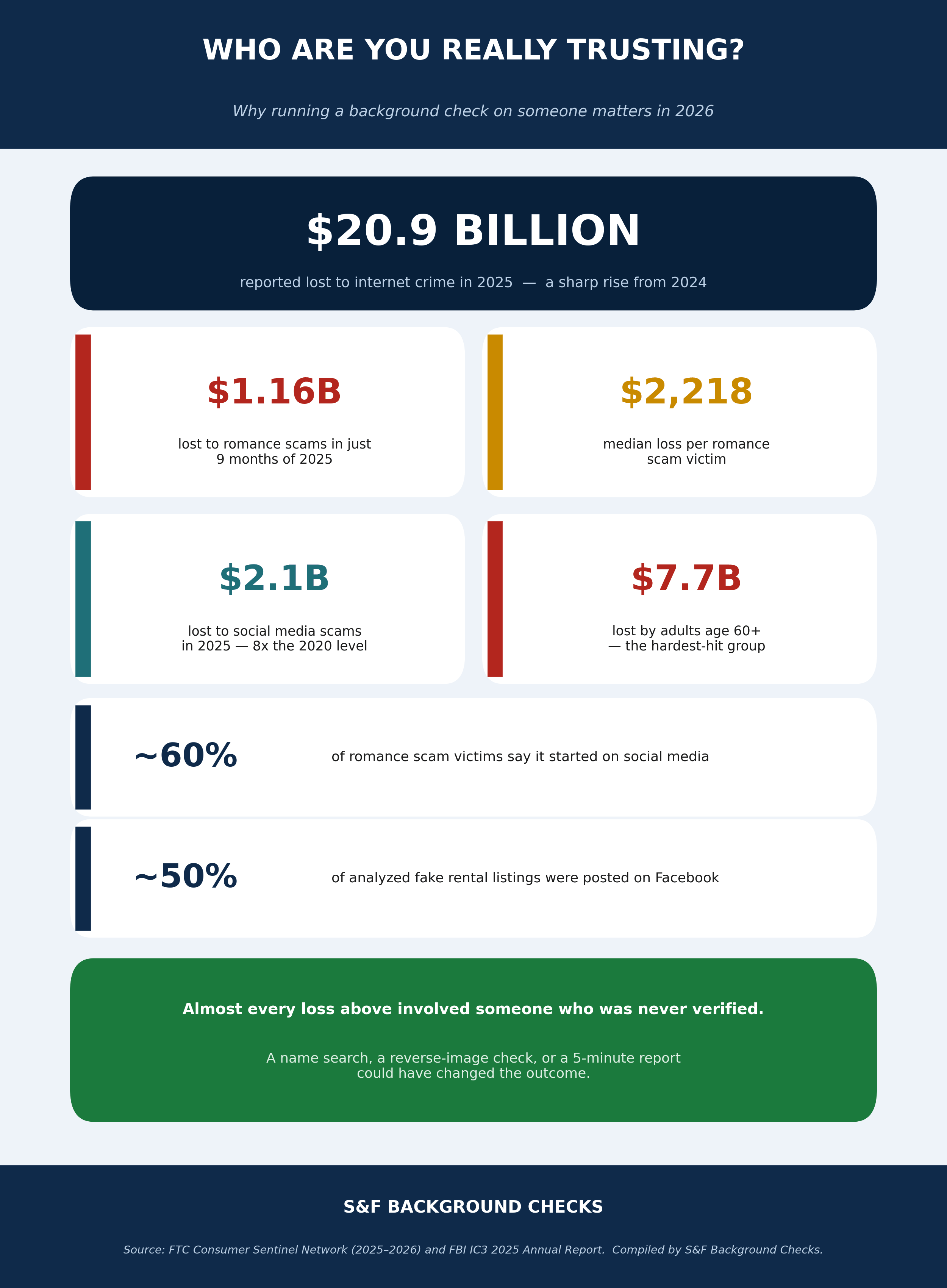
Consider what 2025 looked like, according to federal data:
Read those numbers again. Almost every one represents a transaction with a person who was never verified. A name searched. A photo reverse-imaged. A record pulled. Any one of those steps could have changed the outcome.
That's the entire argument for knowing how to check someone before you trust them.
Even careful people make avoidable errors. Here are the ones that cause the most damage.
Trusting a single free source. One county search or one social profile is a sample, not a verdict. Records are fragmented across jurisdictions; relying on one source guarantees blind spots.
Matching the wrong person. Without a date of birth and SSN to anchor the search, you can confidently attach a stranger's criminal record to an innocent person who happens to share their name. This is the most common — and most harmful — DIY mistake.
Treating people-search sites as real reports. They're data aggregators, not CRAs. Their data is often outdated or inaccurate, and it's legally off-limits for hiring or leasing decisions.
Ignoring jurisdiction. A national database search feels comprehensive but often lags behind county-level filings. A recent charge may not have propagated yet. Knowing where someone has actually lived determines where you need to look — and pending matters have their own rules, as we cover in whether pending charges show up on a background check.
Skipping consent when it's required. For employment or tenant screening, running a check without written authorization is an FCRA violation — full stop. It doesn't matter how informal the context felt.

Can I run a background check on someone without them knowing? For personal, non-regulated reasons — like checking an online match or a stranger — yes, you can search public records without notifying them. But if you're using a check to make an employment, tenant, or credit decision, the FCRA requires written consent first.
What's the fastest way to run a background check on someone? A professional screening service. A DIY search across courts and registries can take hours; a CRA report anchored to a verified identity often returns results in minutes.
Are free background checks accurate? They can be a useful first pass, but they're frequently incomplete and prone to wrong-person matches. For any decision that matters, a verified report is far more reliable.
Do free people-search websites count as background checks? No. They're data aggregators, not consumer reporting agencies, and they openly state their reports can't be used for employment, tenant, or credit screening.
How much does it cost to run a background check on someone? Free public-records searches cost nothing but your time. Professional reports vary by scope and depth — see S&F's pricing for current options.
What information do I need to run a background check? At minimum, a full legal name and, ideally, a date of birth. For an accurate professional report, the subject's Social Security number (collected via consent) dramatically improves accuracy.
Here's the truth.
Every time you hire someone, rent to someone, let someone into your home, or trust someone you met online, you're making a bet. Sometimes that bet is harmless. Sometimes it costs $2,218, or $67,000, or a whole lot more.
Learning how to run a background check on someone is no longer optional due diligence — it's basic self-protection. And while you can piece it together for free across a dozen county websites, you don't have to spend your afternoon doing it.
S&F Background Checks does it in minutes: accurate, anchored to verified identity, and built to give you a real answer instead of a guess.
Stop guessing. Start knowing.