
Your background check just came back. You were expecting "clear." Instead it says "consider."
Your stomach drops. You start running through every mistake you have ever made. You wonder if the job offer you spent weeks working toward just slipped out of your hands.
Take a breath. "Consider" does not mean rejected. It means the screening company found something in your report that requires a human being to evaluate before a hiring decision is made. It is a flag, not a verdict.
Understanding what this status actually means, what triggers it, what your rights are, and how to respond is the difference between handling it professionally and panicking your way out of a job offer you might still get.
This guide covers everything. What consider means on platforms like Checkr and Sterling, what commonly triggers the status, what employers are legally required to do after receiving it, your FCRA rights as a candidate, and exactly how to respond if your check comes back with this result.
Quick answer: "Consider" means the background check is complete and contains information that an employer needs to evaluate before making a hiring decision. It is not a rejection. The screening company does not make the hiring decision. The employer does. And the law requires employers to follow a strict process before they can decline you based on what they found.
The term "consider" is used by major background check platforms including Checkr, Sterling, HireRight, and others to indicate that a background report is complete and contains information that requires employer review before a hiring decision can be made.
As Workable's documentation explains it in clear terms: "Consider means that the investigation has found something that you may wish to consider before proceeding with the hiring process. Items marked 'consider' are there to facilitate your hiring decision, not to make the decision on your behalf."
This is the critical distinction. The background check company is not deciding whether to hire you. The screening platform is flagging information and handing it to the employer for judgment. The employer then has to look at what was found, assess its relevance to the specific job, and decide whether to proceed, delay, or decline.
According to ScoutLogic, a consider status is not necessarily a bad sign. It means something was found, but it does not mean that something automatically disqualifies you. Minor issues, resolvable discrepancies, and misunderstandings all routinely generate a consider flag that gets cleared after a conversation.
Consider vs. Other Background Check Statuses
Understanding consider in context means knowing what the other statuses mean:
.webp)
A consider flag can be generated by a wide range of findings. Some are serious. Many are not. Here are the most common triggers and what each one typically means in practice.
Criminal Record Found
This is the most frequent cause. Any criminal conviction, pending charge, or flagged offense in the court record search triggers a consider status. The finding could be a decade-old misdemeanor, a dismissed case that still appears in some databases, a recent DUI, or something more significant. According to Avvanz Global, criminal record findings require the employer to assess the severity of the offense, when it occurred, and whether it has any genuine relevance to the role before making a decision.
A 15-year-old shoplifting conviction generating a consider status on an application for a marketing role is a very different situation from a recent financial fraud charge generating the same flag for a CFO position. The status looks identical on paper. The weight it carries is completely different.
Employment History Discrepancy
Mismatches between what a candidate listed on their resume and what the verification process found are a common trigger. This could be an employment date that is off by a month, a job title that does not precisely match what the employer has on record, a position that could not be verified because the company no longer exists, or an employer that did not respond to the verification request. As ScoutLogic explains, even minor errors require manual review even if they are clearly innocent mistakes.
In many cases, an employment verification consider flag gets resolved quickly once the candidate provides supplemental documentation such as an offer letter, pay stubs, a W-2, or a LinkedIn profile with the correct dates. The flag itself is not an accusation of dishonesty.
Education Verification Issue
If a listed degree cannot be confirmed, if the graduation date does not match institutional records, if the institution is unaccredited, or if the name under which the degree was earned differs from the legal name on the application, an education verification will return a consider status.
This category can also surface situations where a candidate listed a degree they did not complete, which is a more significant issue. But it equally catches innocent situations like a candidate who got married and changed their name, or who attended under a different name than what appears on their current ID.
Credit or Financial Flag
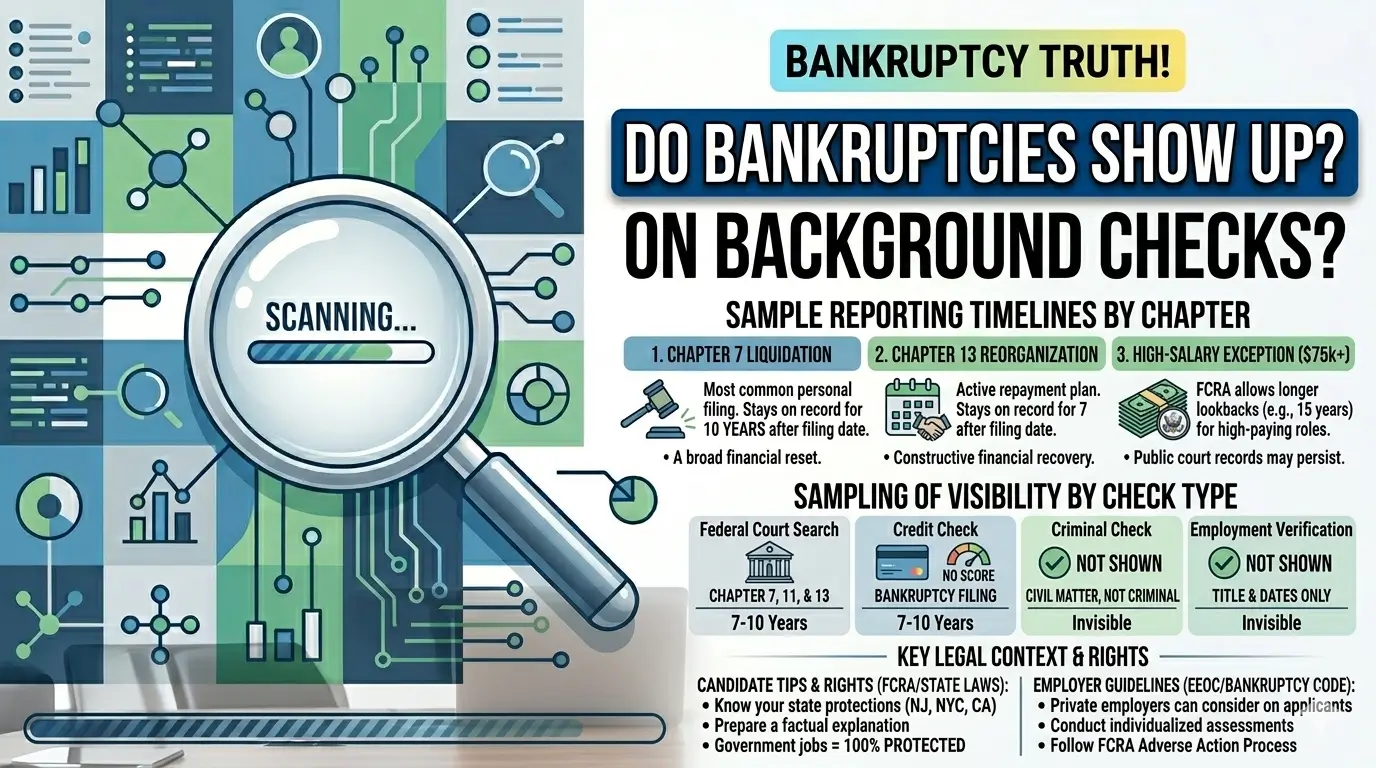
For roles involving financial responsibility, access to financial systems, or fiduciary duties, employers may run a credit check as part of the background package. Significant derogatory items, a recent bankruptcy, multiple accounts in collections, or other patterns of financial distress can generate a consider status. According to Precise Hire, a single past credit issue may be flagged for consideration but not be disqualifying if the candidate has shown efforts to improve their financial situation.
Pending Legal Matters
Active court cases, civil suits, or unresolved legal matters that appear in records searches can trigger a consider status. A pending charge is not a conviction, and an employer is legally required to assess it accordingly. But the presence of unresolved litigation is information the employer wants to be aware of before making a hiring decision.
Drug Screening Result
A non-negative drug test result, meaning a test that was not immediately cleared as negative and requires further review or confirmation testing, can generate a consider status. This is especially common for safety-sensitive positions in transportation, healthcare, and heavy industry where substance screening is strictly regulated.
License or Certification Issue
For roles requiring professional licenses or certifications such as nursing, law, financial advising, or contracting, a discrepancy between what was listed and what the licensing board or certification body confirms on record will trigger a consider status. An expired license, a license with disciplinary history, or a certification issued under a different name are common causes.
Important: The same consider status can mean very different things depending on what triggered it. An employment date mismatch is vastly different from a felony conviction. Both generate the same flag in the system. How the employer responds to each is where the real evaluation happens.
Here is where most candidates do not know the full picture. When an employer receives a consider status, the law does not let them simply decline the candidate and move on. There is a required process, and skipping steps in that process is a federal violation.
Step 1: Conduct an Individualized Assessment
Before taking any adverse action based on a background check finding, particularly for criminal records, the EEOC requires employers to conduct what is called an individualized assessment. This means evaluating the specific finding in context of the specific job, not applying a blanket policy that automatically disqualifies anyone with a flag.
The EEOC's framework, built on the Green Factors from a 1975 court case, asks three questions: What is the nature and gravity of the offense or issue? How much time has passed? How relevant is it to the specific job duties being performed? These three questions form the foundation of a legally defensible assessment.
In some jurisdictions including New York City and Los Angeles, conducting an individualized assessment before taking adverse action based on criminal history is a legal requirement, not just a best practice.
Step 2: Contact the Candidate for Explanation
Before making a final decision, employers should give the candidate an opportunity to explain the finding. According to PDX Fingerprinting, employers typically welcome clarification. A discrepancy in employment dates might be immediately explained by a candidate who worked at a company that was later acquired and renamed. A criminal record might come with significant context about rehabilitation, time elapsed, and irrelevance to the role.
This step protects both parties. Candidates get a fair chance to address the finding. Employers reduce the risk of making a bad decision based on incomplete or inaccurate information.
Step 3: If Declining, Follow the FCRA Adverse Action Process
If an employer decides to move forward with declining the candidate based on the background check findings, the Fair Credit Reporting Act mandates a specific three-step process. This process exists to give candidates a fair opportunity to review what was found and correct any errors before a final decision is made.
Pre-adverse action notice: The employer must send the candidate a written notice stating they are considering not proceeding based on the background check. This notice must include a complete copy of the background check report and the CFPB-approved Summary of Your Rights Under the FCRA. This notice must be sent before any final decision is made.
Waiting period: After sending the pre-adverse notice, the employer must wait a reasonable period before making a final decision. According to DISA, five business days is the standard minimum. Some states and cities require longer waiting periods. During this window, the candidate can review the report, dispute any inaccuracies, or provide additional context.
Final adverse action notice: If the employer proceeds with declining after the waiting period, they must send a final adverse action notice. This notice must include the name, address, and phone number of the background check company that produced the report, a statement that the screening company did not make the hiring decision and cannot explain it, and the candidate's right to request a free copy of the report within 60 days.
What Happens If Employers Skip These Steps?
The consequences are real. According to Checkr's compliance data, 70% of employers surveyed say they do not always follow the adverse action process when declining based on a background check. FCRA violations carry statutory damages of $100 to $1,000 per violation per individual, plus attorney fees. Class action suits over background check violations are one of the fastest-growing areas of employment law.
Skipping the pre-adverse notice, failing to wait the required period, or not providing the complete report are all violations even if the underlying hiring decision was legally sound. The process itself is a protected consumer right.
If you receive notice that your background check has returned a consider status, or if you receive a pre-adverse action notice from an employer, here is the practical framework for responding.
Do Not Panic and Do Not Assume Rejection
A consider status is not a rejection letter. Many candidates with consider statuses still receive job offers after the review process is completed. The flag means someone needs to look more carefully, not that the answer is automatically no. Treating it as a death sentence before any final decision is made will work against you in any follow-up conversation with the employer.
Request a Copy of Your Report Immediately
Under the FCRA, if you receive a pre-adverse action notice, you are entitled to a copy of the background check report. Read it carefully. Identify exactly what was flagged. According to iprospectcheck, check every detail: Is the record actually yours? Is the disposition correctly noted? Is the information current or outdated? Errors in background checks are more common than most people realize.
Dispute Any Inaccuracies Immediately
If anything in the report is wrong, file a dispute with the screening company, not with the employer. The FCRA gives the screening company 30 days to investigate and correct inaccurate information. Act quickly because the employer's waiting period is running. A dispute does not stop the clock, but a correction could change the outcome.
Common errors worth disputing include records that belong to someone with a similar name, charges that were dismissed or expunged but still show as active, incorrect dates, outdated information that should no longer be reportable, and identity mismatches.
Prepare a Clear, Professional Explanation
For accurate findings that you want to address, prepare a concise, factual explanation. The best responses acknowledge the finding directly, provide relevant context, demonstrate time elapsed or rehabilitation since the event, and explain why it does not affect your ability to perform the specific role. Avoid being defensive, emotional, or evasive. Two to four sentences is usually enough unless the employer wants more.
Gather Supporting Documentation
If you have documentation that supports your explanation, gather it before the conversation. Dismissal records for charges that were dropped. Proof of a degree earned under a different legal name. Pay stubs or W-2 forms that confirm employment dates that could not be verified by phone. Character references or evidence of professional rehabilitation since a past offense.
Contact HR or the Hiring Manager Proactively
If the employer has not reached out after sending a pre-adverse notice, you can contact them proactively during the waiting period to express your continued interest and offer to address any questions about the report. This signals professionalism and confidence rather than avoidance. Keep the tone matter-of-fact and solution-oriented.
Know Your Timeline
The employer must wait at least five business days after the pre-adverse notice before making a final decision. Use that window. If you need to gather documentation, dispute an error, or prepare a written explanation, that waiting period is your opportunity. Do not wait until the final adverse action notice arrives to respond.
The term consider is industry-standard, but the way it is presented and what information accompanies it varies slightly between platforms.
Checkr
Checkr, one of the largest background check platforms in the US, uses consider as a standard status that means the report is complete and contains adverse information for the employer to evaluate. As Checkr's documentation states, a consider status does not mean the candidate has been disqualified from employment or engagement. Checkr's platform includes a Candidate Stories feature that allows employers to request additional context directly from the candidate before making a decision. For more details, see Checkr's documentation.
Sterling
Sterling uses the same consider terminology and emphasizes that the status is a data delivery mechanism, not a decision. Sterling's adverse action guidance is detailed and emphasizes building a consistent, documented process for handling consider statuses across all candidates to ensure non-discriminatory application of hiring criteria.
HireRight, First Advantage, and Others
All major background check providers use equivalent terminology and operate under the same FCRA and EEOC framework. The specific labels may differ slightly (some use "review required" or "escalate" rather than "consider"), but the underlying meaning and the legal obligations that follow are consistent across providers.
Yes. The same consider flag carries different weight depending on the industry, the role, and the type of finding.
Financial Services
A consider status triggered by a criminal fraud charge is far more significant for a financial advisor position than for a warehouse manager role. Regulated financial industries have specific legal restrictions on certain types of hires, meaning some consider statuses in these environments are functionally mandatory declinations regardless of individualized assessment.
Healthcare and Education
Positions involving vulnerable populations have the lowest tolerance for unresolved consider statuses. A drug test consider flag for a pediatric nurse role or a criminal assault flag for a childcare worker generates a much more serious review process than the same flag for a software developer.
Government and Security Clearances
Background checks for government positions and security clearances operate under separate frameworks with their own adjudicative guidelines. A consider equivalent in a clearance investigation triggers a thorough review process that can extend the timeline by months.
Technology and General Corporate
Most technology companies and general corporate employers handle consider statuses through standard HR review processes. Minor employment discrepancies and older, unrelated criminal records frequently generate consider flags that are resolved quickly with minimal impact on the hiring decision.
Does "consider" on a background check mean I will not get the job?
Not automatically. Consider means something was flagged for employer review, not that you have been rejected. Many candidates with consider statuses are ultimately hired after the employer reviews the finding, conducts an individualized assessment, and in some cases speaks with the candidate directly. The final decision belongs to the employer, not the screening company.
How long does a consider status take to resolve?
It depends on the employer's internal review process and what was flagged. A simple employment verification discrepancy that the candidate can clarify with a pay stub might be resolved in hours. A criminal record that requires a full individualized assessment and candidate conversation might take several business days. The FCRA requires a minimum five-business-day waiting period before a final adverse decision, so the process has a built-in floor.
What is the difference between "consider" and "clear" on a background check?
Clear means no issues were found and the hiring process can proceed without additional review. Consider means the report is complete but contains information that requires a human decision before the process can move forward. Clear is straightforwardly positive. Consider requires employer evaluation and potentially a conversation with the candidate.
Can I still get hired after a consider status?
Yes. A consider status is not a rejection. It is a flag that requires review. Many candidates are hired despite receiving a consider status, particularly when the finding is minor, unrelated to the role, old, or explainable. The outcome depends on what was found, how the employer assesses it, and how the candidate responds if given the opportunity to provide context.
Should I contact the employer if my background check says consider?
Yes, once you have received a pre-adverse action notice, you have a right to respond during the waiting period. If no pre-adverse notice has been received and you are simply aware that your check returned a consider status from another source, you can reach out to HR to express continued interest and offer to address any questions about your report. Being proactive signals transparency.
What if the consider status was caused by an error in my background check?
File a dispute with the background check company immediately. Under the FCRA, they have 30 days to investigate and correct inaccurate information. You can also notify the employer that you are disputing an error in the report. For more on your rights, see iprospectcheck's FCRA guide.
Does a consider status follow me to other employers?
No. Background checks are conducted independently by each employer. A consider status on one application does not create a permanent flag that appears in future background checks for different employers. Each new background check is a fresh pull of your current records at that point in time.
A consider status on your background check is not a closed door. It is a request for a closer look.
The screening company found something that required flagging. The employer now has to evaluate it. You have rights in that process. You have time to respond. You can dispute errors. You can provide context. And the law requires the employer to follow specific steps before they can decline you.
The candidates who handle a consider status best are the ones who stay calm, pull their own report, verify the accuracy of what was found, prepare an honest and professional explanation for anything accurate, and engage with the employer process proactively rather than disappearing or waiting passively.
Consider means the conversation is not over. In many cases, it means the conversation has just started.
Sources
ScoutLogic: What Does Consider Mean on a Background Check
Checkr: The Basics of Adverse Action
Checkr: FCRA Compliance and Adverse Action Violations
Sterling: Adverse Action Best Practices Under the FCRA
iprospectcheck: Adverse Action and Employment Background Checks
DISA: FCRA Adverse Action Process Step-by-Step Guide
SHRM: FCRA 101 How to Avoid Risky Background Checks
Avvanz Global: What Does Consider Mean on a Background Verification Check
Precise Hire: Things Employers Consider in Background Checks
PDX Fingerprinting: What Does Consider Mean on a Background Check